At a glance, culture and cosmology seem disparate, if similarly nebulous. The romantic, starry arc of sky still seems ancient and impenetrable, whereas mankind's artistic and social development has plodded along at a pretty steady (if accelerating) rate, easily charted, easily dissected, maybe hopelessly self-aware.
In the past few years, this notion of inseparability has come under scrutiny, and physicists have burnished proof from everyone from Einstein to Bohr that all matter, all action, is interwoven to produce a constantly "becoming" universe. One of these is astrophysicist Adam Frank, whose new book The End of the Beginning: Cosmology, Time and Culture at the Twilight of the Big Bang argues that time (cosmology) and people (culture) are entangled entities that continue to influence each other, raising big questions about what time is, exactly, and how much we've come to rely on our definition of it. Frank goes on to investigate how quantum physics troubles any notion of a linear time--i.e., 2012 being after 2011--and instead suggests that the multiverse may exist outside of time altogether. This, in turn, suggests that our notion of the Big Bang may not be what we think--that our Bang was just one of an infinite number.
Another astrophysicist, Julian Barbour, has long advocated for a theory that eclipses time as a slow march toward death. Sean Carroll wrote recently that Barbour "thinks that if we just understood the laws of physics better, "time" would disappear from our vocabulary."
On the other side of the academic divide, popular internet documentary-maker David Wilcock is releasing a tome containing his life's work next month, titled The Source Field Investigations: The Hidden Science and Lost Civilizations Behind the 2012 Prophecies. That's a mouthful, and a sort of fantastical title that I suspect is designed to make headlines rather than attract serious-minded science readers, but the book itself contains a vast and intriguing number of facts and theories that I found completely thought-provoking. Of particular interest were his chapters on time, which he argues is three-dimensional, and on the interaction of light and DNA--specifically, that DNA carries information to and from bodies in re-usable photon packets, and that via certain kinds of light frequencies, DNA can actually be re-written on the spot. What?! It's mind-boggling, sci-fi stuff, and all the more pleasurable because some of it makes a lot of sense, and furthermore, is really gorgeous to imagine. Wilcock spends a lot of time on his theory that the secret to gravity can be solved using geometry; that the universe is constructed along immense Platonic forms. Given mankind's penchant for mathematics throughout history--from the pyramids to astrology to the precise chopping up of a day's minutes--it's tempting to believe it.
Along that sublime intersection of science and art, enjoy this piece about the music of quantum graphs; this one about the art of scientific field notes; and this one about science-inspired tattoos.
And finally, Proust, whose 1.5 million-word novel makes a statement about time simply by asking to be read, writes that we are beings within an accumulating time, that our memory-addled existence occupies immensely more than just "now." Barbour would certainly agree.
Showing posts with label geometry. Show all posts
Showing posts with label geometry. Show all posts
July 19, 2011

July 15, 2010
Euclidian Wordplay
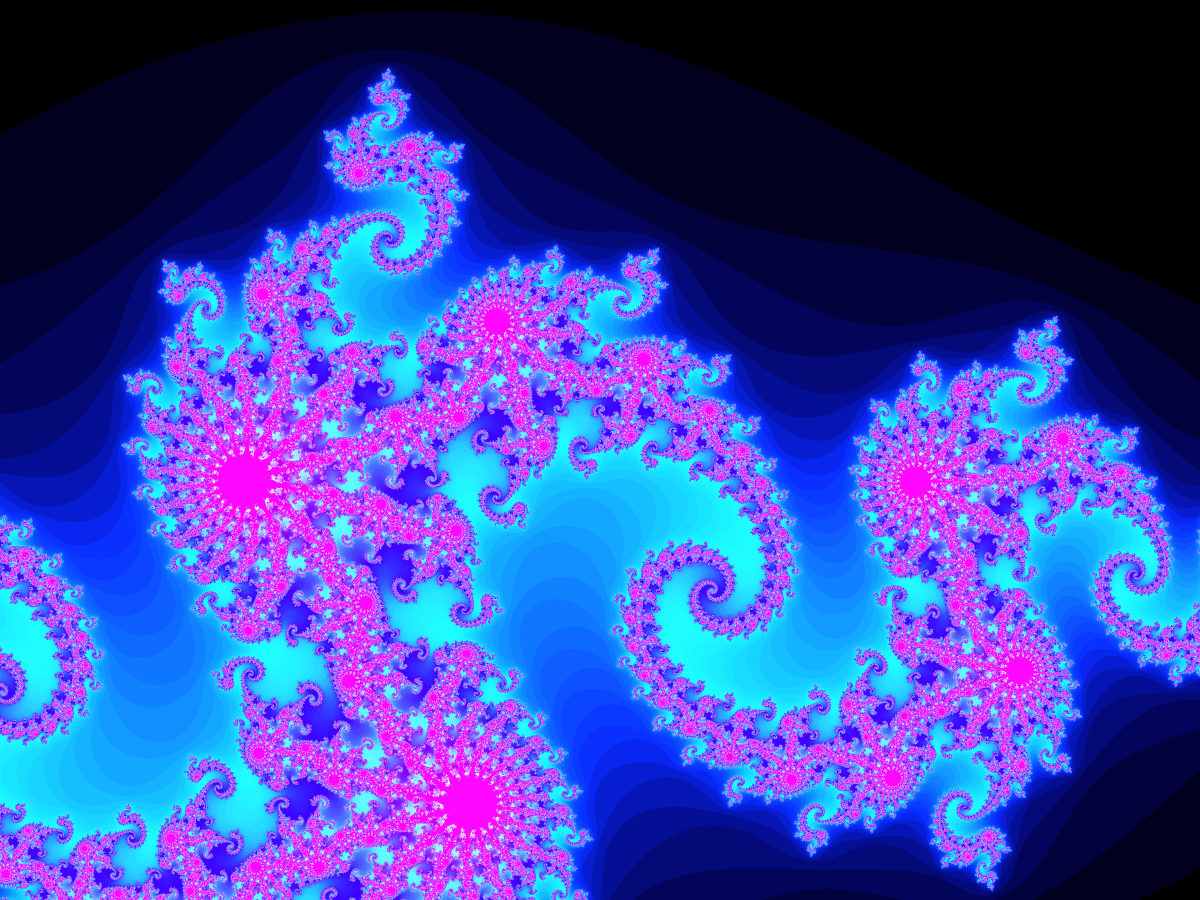
Geometry is one of those fields that seems impossibly relevant, considering its 3rd-century BC foundations, when Euclid standardized the axiomatic form (elemental geometry existed and was utilized long before that), and in comparison with 20th-century theoretical mathematics, which is impossibly complex. But geometry--unlike, say, atomic theory--remains steadfast in its harmonious implications, and today scientists manifest its principles in calculations that range from coordinate algebra to differential geometry to pseudo-Riemannian geometry, which brings us to general relativity, and even string theory. (Remember that Edward Witten's M-theory posits that strings are really one-dimensional slices of a two-dimensional membrane vibrating in 11-dimensional space.) Geometry has proven itself indefatigably accurate, universal, and accessible. And gorgeous: just look at this Julia set fractal.
This month, Ugly Duckling Presse (whose books are always intellectually provocative and beautiful) releases Geometry, a collection of poems by Eugene Guillevic (newly translated by the always astute Richard Sieburth) that pair basic geometric images with delightful verse intending to be the "voice" of the object. For example, 'Hyperbola' concludes: What would it be like / To live as asymptote/ To that which never ends? In another, 'Spiral', an even more implicit relationship with identity emerges:
Paring the space
I enclose in the course
Of my adventure,
Pivoting around
Something I am
And am not
I become the point
To which I tend,
A true self, a center
Which is also not.
Flaubert is quoted as saying "Poetry is as exact a science as geometry." Here, indulge in the artistry of the intersection.
Subscribe to:
Posts (Atom)